Tip: move over the painting to use the lens.
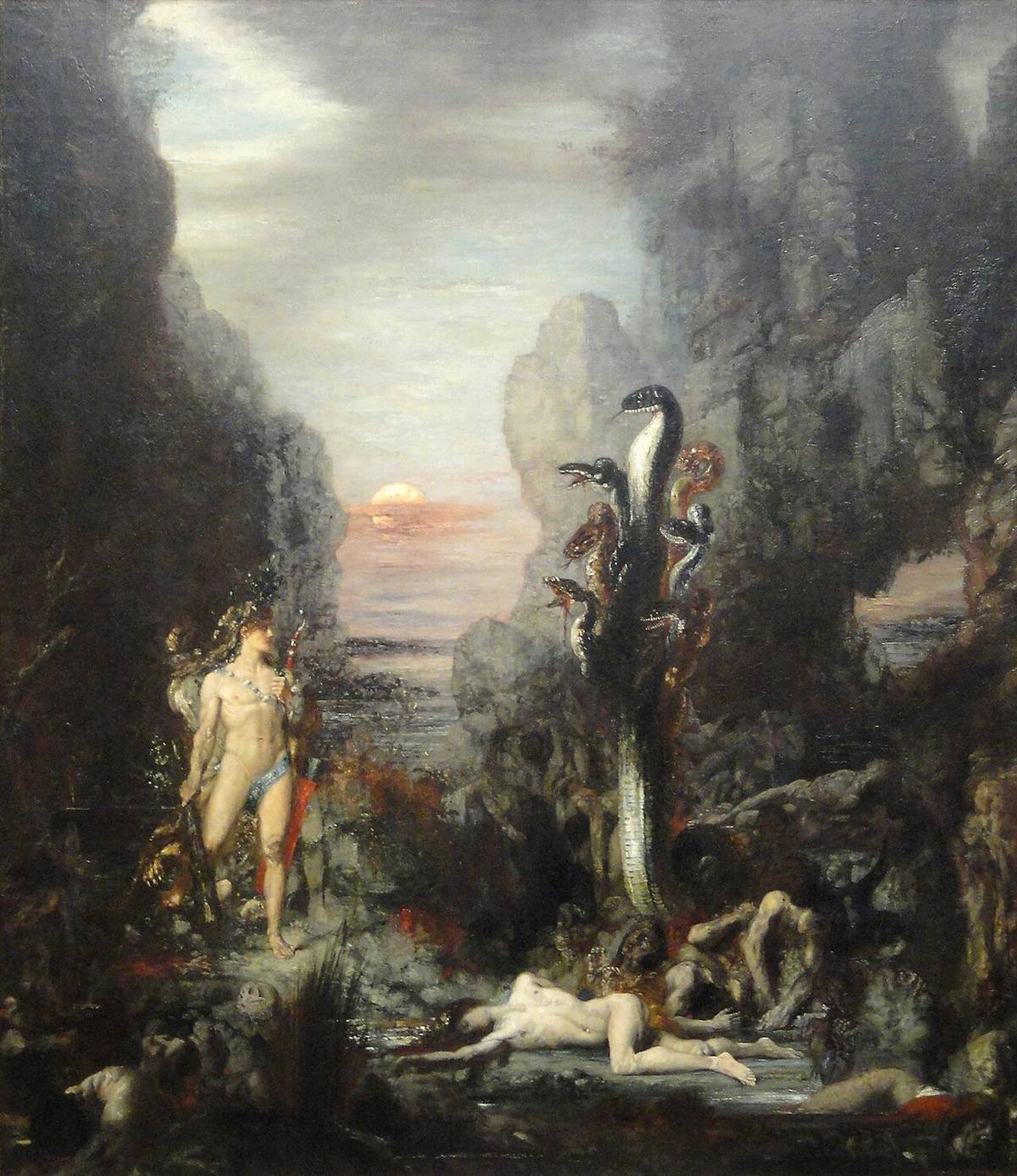
Hercules and the Lernaean Hydra
Gustave Moreau · 1875–76
- Artist
- Gustave Moreau (French, 1826-1898)
- Date
- 1875–76
- Medium
- Oil on canvas
- Size
- 179.3 × 154 cm (70 9/16 × 60 5/8 in.); Framed: 226.7 × 201.9 cm (89 1/4 × 79 1/2 in.)
- Made in
- France
- Style
- nineteenth century
- Where to see it
- Art Institute of Chicago
Gift of Mrs. Eugene A. Davidson · CC0 Public Domain · Art Institute of Chicago · image via Wikimedia Commons · see it at the museum ↗
Notes from the museum
In order to atone for killing his family, the mythical ancient Greek hero Hercules was tasked with completing twelve difficult feats. His second task was to slay the Lernaean Hydra, a water monster with multiple serpentine heads. Gustave Moreau depicted their encounter in this work, exhibited at the Paris Salon of 1876, indulging his taste for the ghoulish. Hercules confronts the Hydra in a swampy landscape, rendered as a primordial ooze of brown paint and strewn with the fragmented and decomposing bodies of previous victims. Calm and youthful, Hercules stands amid the carnage, weapon in hand, ready to sever the Hydra’s seventh, “immortal” head, which he will later bury. Despite the violent subject, the painting seems eerily still, almost frozen. Reinforcing this mysterious quality is Moreau’s ability to combine suggestive, painterly passages with obsessive detail. His precise draftsmanship and otherworldly palette are the result of his painstaking methods; he executed numerous preliminary studies for every detail in the composition, even sketching live snakes at the Paris zoo. Moreau might have intended this mythological painting to express contemporary political concerns: he was profoundly aff ected by France’s military defeat at the hands of Prussia in 1870–71. Hercules might literally personify France; the Hydra could represent Prussia. Whether or not this was the artist’s i
Text: Art Institute of Chicago (open access). Our full story for this work is coming soon.
Slow Look
- The whole picture Let your eyes wander. Where do they want to rest?
- The light Find the brightest spot. What is it showing you?
- The edges Look at what is half cut off at the borders.
- One small detail Choose one tiny thing and stay with it for a while.
- The whole picture again Step back. Has it changed for you?
About Gustave Moreau
Gustave Moreau was a French artist and an important figure in the Symbolist movement. Jean Cassou called him "the Symbolist painter par excellence". He was an influential forerunner of symbolism in the visual arts in the 1860s, and at the height of the symbolist movement in the 1890s, he was among the most significant painters. Art historian Robert Delevoy wrote that Moreau "brought symbolist polyvalence to its highest point in Jupiter and Semele." He was a prolific artist who produced over 15,000 paintings, watercolors, and drawings. Moreau painted allegories and traditional biblical and myth
What do you see?
Stand in front of it for a moment. Then tell us what you noticed or felt - there are no wrong answers.
Be the first to share a thought.
More by Gustave Moreau
If you like this, stand in front of these