Tip: move over the painting to use the lens.
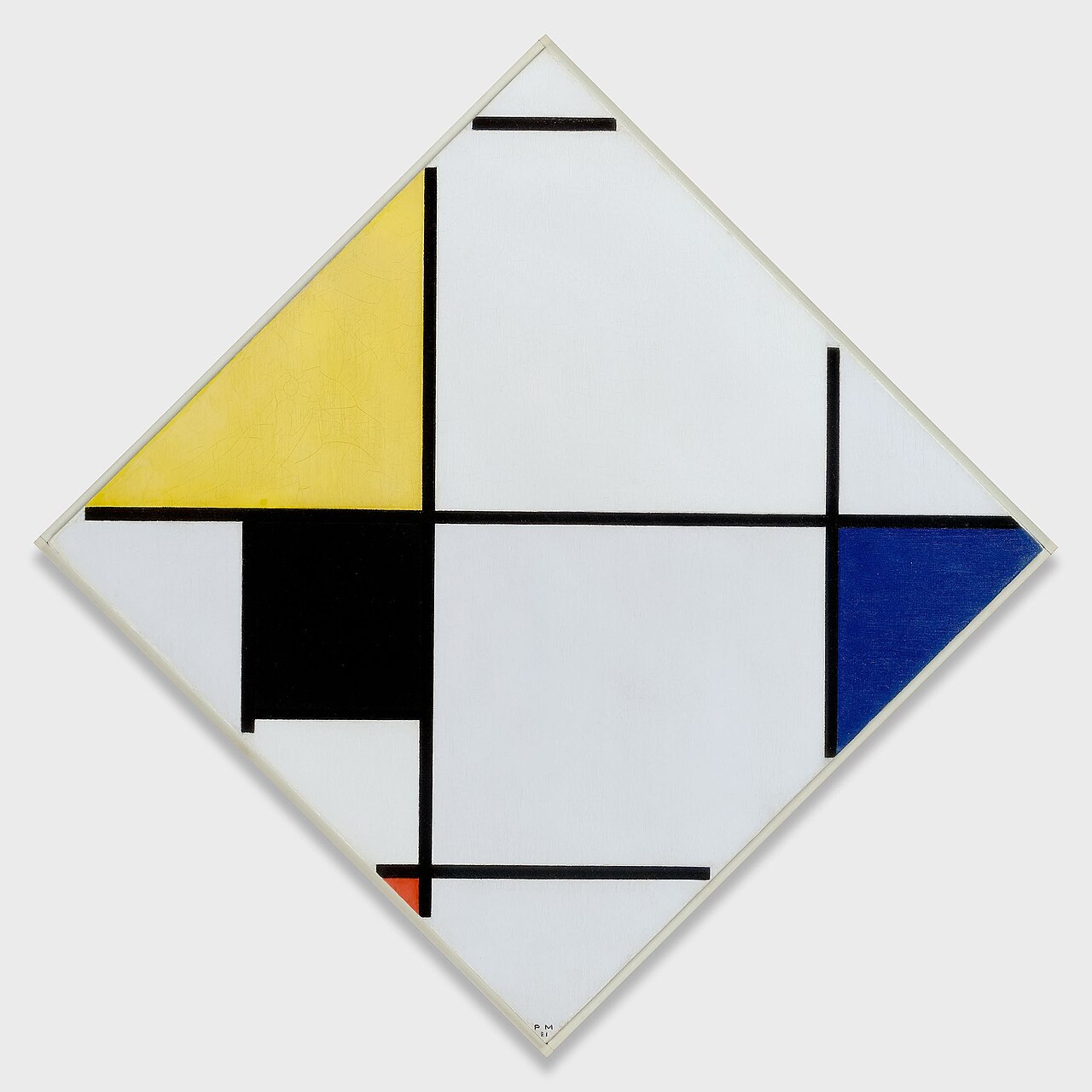
Lozenge Composition with Yellow, Black, Blue, Red, and Gray
Piet Mondrian · 1921
- Artist
- Piet Mondrian Dutch, 1872–1944
- Date
- 1921
- Medium
- Oil on canvas
- Size
- 60 × 60 cm (23 5/8 × 23 5/8 in.)
- Made in
- Netherlands
- Style
- Modernism
- Where to see it
- Art Institute of Chicago
Gift of Edgar Kaufmann, Jr. · CC0 Public Domain · Art Institute of Chicago · image via Wikimedia Commons · see it at the museum ↗
Notes from the museum
Piet Mondrian, a painter of the revolutionary international movement De Stijl (the Style), argued that "the straight line tells the truth." Why, then, we might wonder, would he choose to hang a painting off axis, where its edges imply dynamic diagonals? Among other motivations, rotating the canvas allowed Mondrian to reconsider a question he spent his career exploring, namely, the relationship between the contents of a painting and what contains them. In Lozenge Composition , the squared-off black lines imply enclosure, while a single line (above the blue area) extends to the slanted edge, suggesting extension beyond the canvas. This implication of what might lie beyond also prompted Mondrian to invoke the full expanse of the wall by hanging diagonal paintings well above eye level.
Text: Art Institute of Chicago (open access). Our full story for this work is coming soon.
Slow Look
- The whole picture Let your eyes wander. Where do they want to rest?
- The light Find the brightest spot. What is it showing you?
- The edges Look at what is half cut off at the borders.
- One small detail Choose one tiny thing and stay with it for a while.
- The whole picture again Step back. Has it changed for you?
About Piet Mondrian
Pieter Cornelis Mondriaan, known after 1911 as Piet Mondrian, was a Dutch painter and art theoretician, who is regarded as one of the greatest artists of the 20th century. He was one of the pioneers of 20th-century abstract art, as he changed his artistic direction from figurative painting to an increasingly abstract style, until he reached a point where his artistic vocabulary was taken down to simple geometric elements.
What do you see?
Stand in front of it for a moment. Then tell us what you noticed or felt - there are no wrong answers.
Be the first to share a thought.
If you like this, stand in front of these