Tip: move over the painting to use the lens.
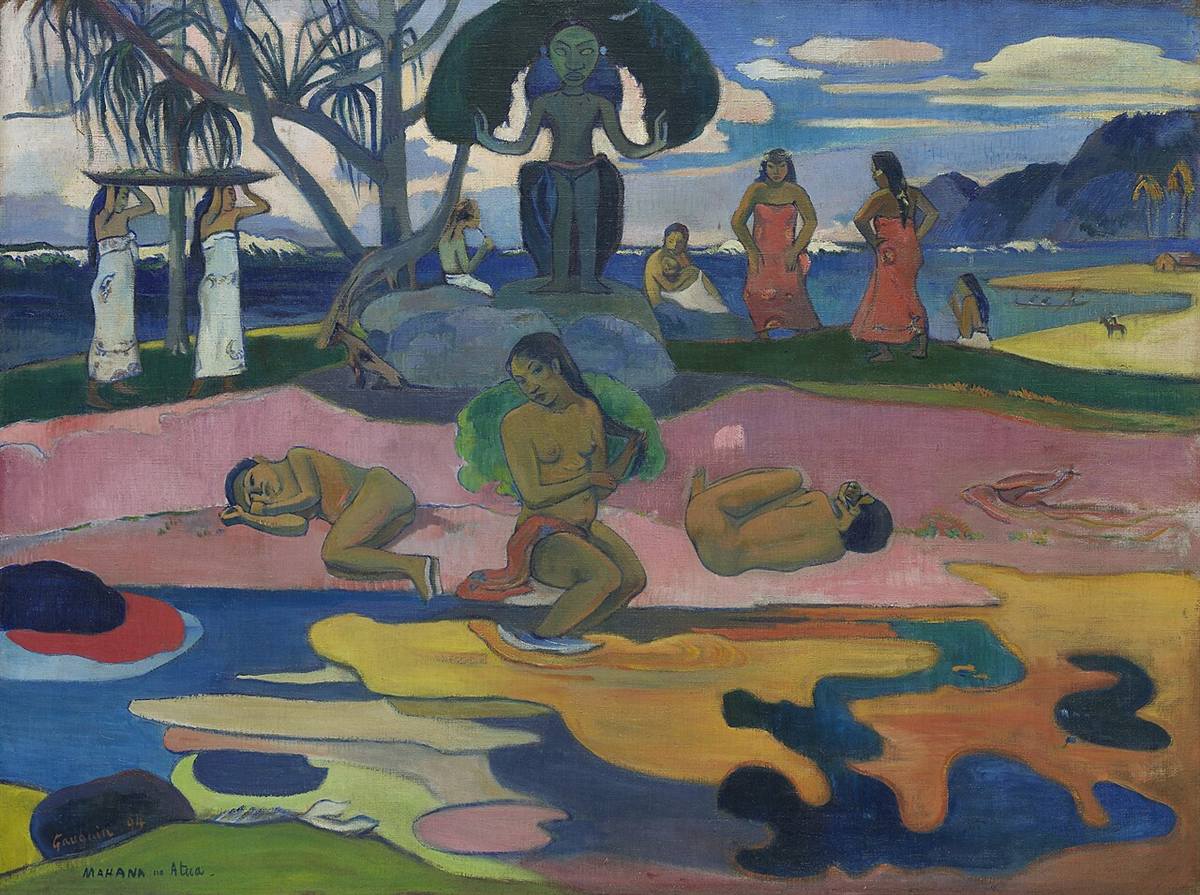
Mahana no atua (Day of the God)
Paul Gauguin · 1894
- Artist
- Paul Gauguin (French, 1848–1903)
- Date
- 1894
- Medium
- Oil on linen canvas
- Size
- 68 × 91 cm (26 7/8 × 36 in.); Framed: 87.7 × 110.5 × 6.4 cm (34 1/2 × 43 1/2 × 2 1/2 in.)
- Made in
- France
- Style
- Post-Impressionism
- Where to see it
- Art Institute of Chicago
Helen Birch Bartlett Memorial Collection · CC0 Public Domain · Art Institute of Chicago · image via Wikimedia Commons · see it at the museum ↗
Notes from the museum
In this tropical paradise of the artist’s invention, a deity presides over figures walking and resting on an embankment. Rhythmically arranged in groups of two and three, the figures appear more as symbolic forms than as portraits of individuals. Pools of water in interlocking, abstract zones of acidic color surround the feet of a bather, who is flanked by two prone figures—or perhaps the same person seen from two angles. Unlike his other Tahitian-inspired landscapes, this painting was produced in Paris shortly after Paul Gauguin’s first trip to the island. Drawn from fantasy and memory, the psychedelic composition is one of the most abstract and avant-garde works of the artist’s career.
Text: Art Institute of Chicago (open access). Our full story for this work is coming soon.
Slow Look
- The whole picture Let your eyes wander. Where do they want to rest?
- The light Find the brightest spot. What is it showing you?
- The edges Look at what is half cut off at the borders.
- One small detail Choose one tiny thing and stay with it for a while.
- The whole picture again Step back. Has it changed for you?
About Paul Gauguin
Eugène Henri Paul Gauguin was a French painter, sculptor, printmaker, ceramist, and writer, whose work has been primarily associated with the Post-Impressionist and Symbolist movements. He was also an influential practitioner of wood engraving and woodcuts as art forms. While only moderately successful during his lifetime, Gauguin has since been recognized for his experimental use of color and Synthetist style that were distinct from Impressionism.
What do you see?
Stand in front of it for a moment. Then tell us what you noticed or felt - there are no wrong answers.
Be the first to share a thought.
More by Paul Gauguin
If you like this, stand in front of these