Tip: move over the painting to use the lens.
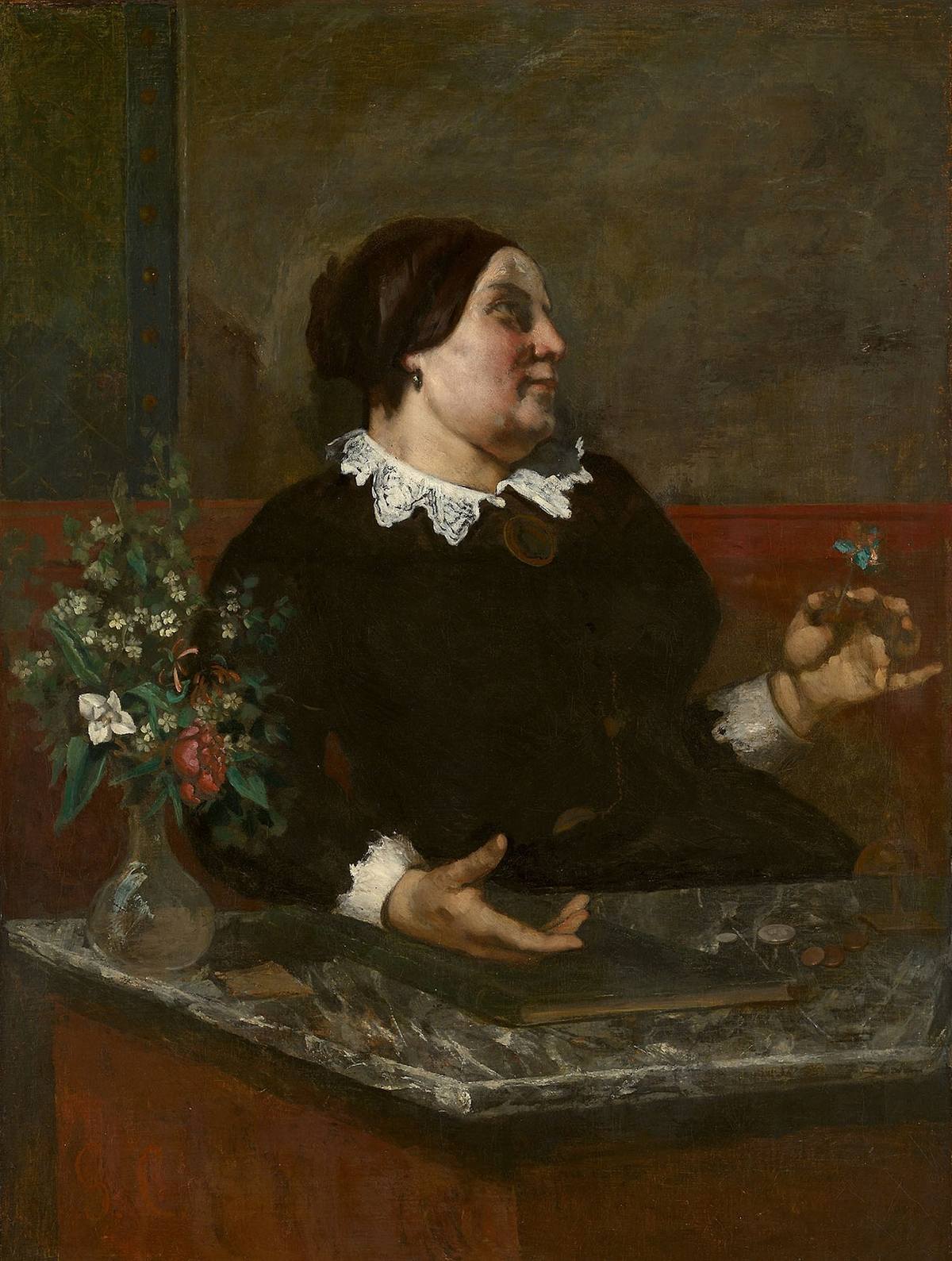
Mère Grégoire
Gustave Courbet · 1855, reworked 1857–59
- Artist
- Gustave Courbet (French, 1819–1877)
- Date
- 1855, reworked 1857–59
- Medium
- Oil on canvas
- Size
- 129 × 97.5 cm (50 3/4 × 38 3/8 in.); Framed: 168 × 137.2 × 16.2 cm (66 1/8 × 54 × 6 3/8 in.)
- Made in
- France
- Style
- 19th century
- Where to see it
- Art Institute of Chicago
Wilson L. Mead Fund · CC0 Public Domain · Art Institute of Chicago · image via Wikimedia Commons · see it at the museum ↗
Notes from the museum
The demurely dressed subject of Mère Grégoire was inspired by the lead character in a popular song written in the 1820s by French lyricist Pierre-Jean de Béranger. Béranger often penned ribald lyrics; his “Madame Grégoire” was the proprietor of a house of prostitution. Gustave Courbet began this work in 1855 as a simple head on a horizontal canvas, but enlarged it to its present dimensions and transformed it into an elaborate genre scene between 1857 and 1859. The artist depicted the woman here in the midst of a transaction, with coins scattered on a marble-topped counter and a ledger beneath her right hand. Under her other hand is the small bell used to summon her female employees. She holds a flower, a symbol of love, which she presumably offers to an unseen customer on the other side of the counter. The painting may also have had a political subtext. Béranger was a fierce opponent of the monarchy, while Courbet followed in his footsteps as a dissident of the Second Empire. In the mid-1850s, when Courbet began this painting, the government had harshly attacked Béranger’s songs in an eff ort to restrict free expression. Courbet’s decision to portray the songwriter’s Madame Grégoire—whose flower exhibits the blue, white, and red of the French flag—may represent a protest not only against government censorship but also against the Second Empire itself. Thus the artist transformed th
Text: Art Institute of Chicago (open access). Our full story for this work is coming soon.
Slow Look
- The whole picture Let your eyes wander. Where do they want to rest?
- The light Find the brightest spot. What is it showing you?
- The edges Look at what is half cut off at the borders.
- One small detail Choose one tiny thing and stay with it for a while.
- The whole picture again Step back. Has it changed for you?
About Gustave Courbet
Jean Désiré Gustave Courbet was a French painter who led the Realism movement in 19th-century French painting. Committed to painting only what he could see, he rejected academic convention and the Romanticism of the previous generation of visual artists. His independence set an example that was important to later artists, such as the Impressionists and the Cubists. Courbet occupies an important place in 19th-century French painting as an innovator and as an artist willing to make bold social statements through his work.
What do you see?
Stand in front of it for a moment. Then tell us what you noticed or felt - there are no wrong answers.
Be the first to share a thought.
More by Gustave Courbet
If you like this, stand in front of these