Tip: move over the painting to use the lens.
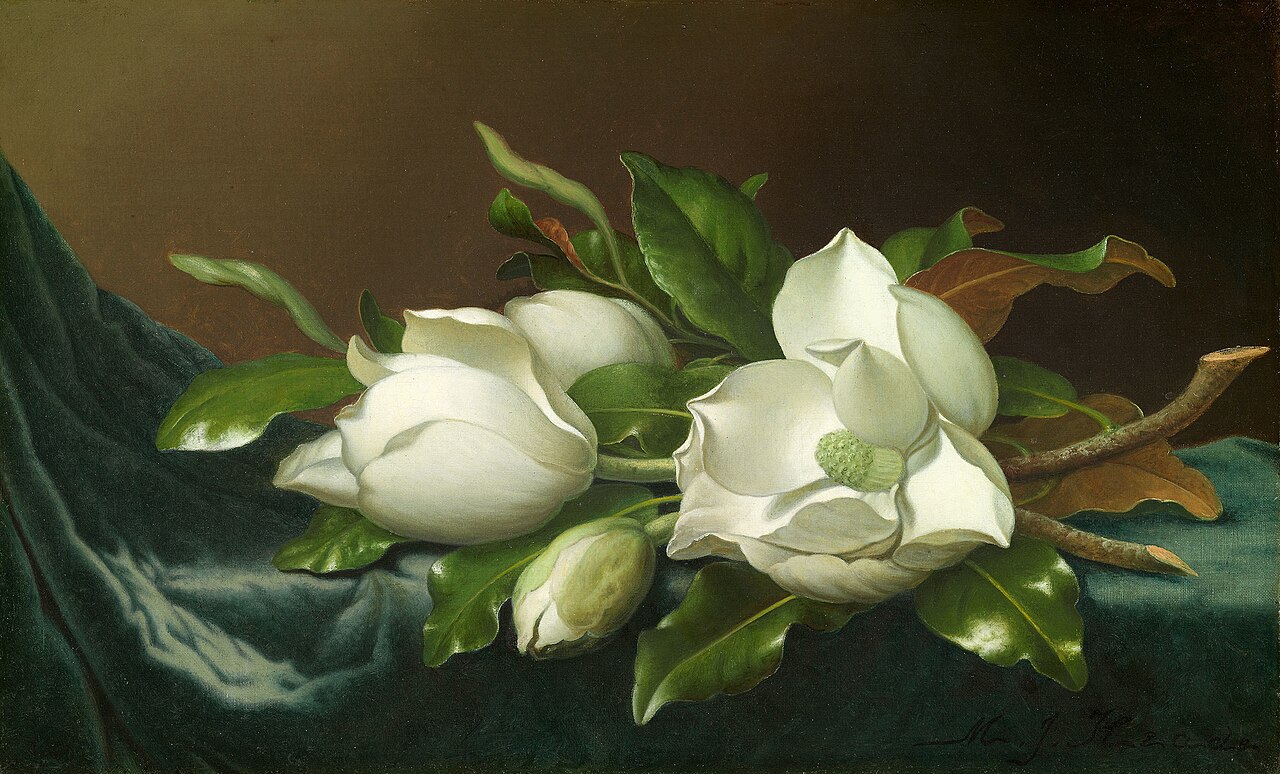
Magnolias on Light Blue Velvet Cloth
Martin Johnson Heade · 1885–95
- Artist
- Martin Johnson Heade (American, 1819–1904)
- Date
- 1885–95
- Medium
- Oil on canvas
- Size
- 38.6 × 61.8 cm (15 1/4 × 24 3/8 in.)
- Made in
- Florida
- Where to see it
- Art Institute of Chicago
Purchased with funds provided by Gloria and Richard Manney; Harold L. Stuart Endowment Fund · CC0 Public Domain · Art Institute of Chicago · image via Wikimedia Commons · see it at the museum ↗
Notes from the museum
This sensuous and decorative image dates from the later part of Martin Johnson Heade’s long, varied, and peripatetic career. Traveling through much of the United States, to England and continental Europe, and (three different times) to Brazil, he produced work ranging from pristine views of East Coast salt marshes and lush tropical landscapes to pictures of exotic hummingbirds and orchids. At the age of sixty-four, Heade settled in Saint Augustine, Florida. There he began painting detailed arrangements of native flowers, including the Cherokee rose, orange blossom, and magnolia. Stretched out like an odalisque on blue velvet cloth, the curvaceous magnolia was meticulously rendered in pale, subtle hues and illuminated by a light so sharp that the image evokes the hyperintensity of a dream. The warm, steamy atmosphere is almost palpable, as is the blossom’s heady, pungent scent. The Art Institute’s Magnolias is one of a number of compositions by the artist featuring this dramatic yet delicate white flower.
Text: Art Institute of Chicago (open access). Our full story for this work is coming soon.
Slow Look
- The whole picture Let your eyes wander. Where do they want to rest?
- The light Find the brightest spot. What is it showing you?
- The edges Look at what is half cut off at the borders.
- One small detail Choose one tiny thing and stay with it for a while.
- The whole picture again Step back. Has it changed for you?
About Martin Johnson Heade
Martin Johnson Heade was an American painter known for his salt marsh landscapes, seascapes, and depictions of hummingbirds, often depicted with orchids, as well as lotus blossoms and other still lifes. His painting style and subject matter, while derived from the romanticism of the time, are regarded by art historians as a significant departure from those of his peers.
What do you see?
Stand in front of it for a moment. Then tell us what you noticed or felt - there are no wrong answers.
Be the first to share a thought.
If you like this, stand in front of these