Tip: move over the painting to use the lens.
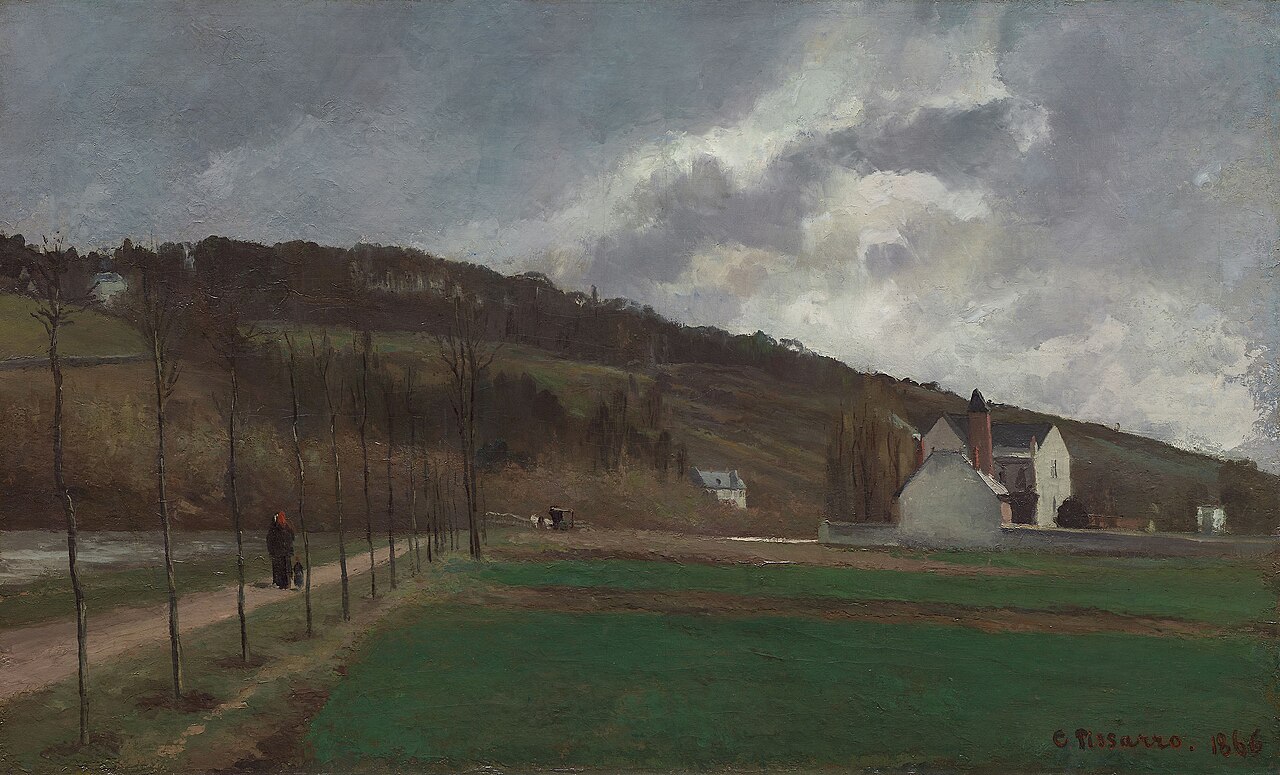
The Banks of the Marne in Winter
Camille Pissarro · 1866
- Artist
- Camille Pissarro (French, 1830–1903)
- Date
- 1866
- Medium
- Oil on canvas
- Size
- 91.8 × 150.2 cm (36 1/8 × 59 1/8 in.); Framed: 119.7 × 178.5 × 10.2 cm (47 1/8 × 70 1/4 × 4 in.)
- Made in
- France
- Style
- Impressionism
- Where to see it
- Art Institute of Chicago
Mr. and Mrs. Lewis Larned Coburn Memorial Collection · CC0 Public Domain · Art Institute of Chicago · image via Wikimedia Commons · see it at the museum ↗
Notes from the museum
This painting of a rural winter landscape is resolutely un-picturesque. Its dark color palette is uninterrupted by any majestic natural elements, such as towering trees or a glittering pond. Even early in his career, Camille Pissarro subverted traditional landscape painting by deliberately diverging from the pastoral scenes of his mentor, Camille Corot . In this large, rectangular canvas, Pisarro applied paint heavily, often using a palette knife, in emulation of Gustave Courbet , whose work is on view nearby. Just a few years after he made this work, Pissarro adopted a more immediate approach to landscape painting, working en plein air (outdoors) directly from nature rather than in a studio, a technique closely associated with the Impressionists.
Text: Art Institute of Chicago (open access). Our full story for this work is coming soon.
Slow Look
- The whole picture Let your eyes wander. Where do they want to rest?
- The light Find the brightest spot. What is it showing you?
- The edges Look at what is half cut off at the borders.
- One small detail Choose one tiny thing and stay with it for a while.
- The whole picture again Step back. Has it changed for you?
About Camille Pissarro
Jacob Abraham Camille Pissarro was a Danish-French Impressionist and Neo-Impressionist painter born on the island of Saint Thomas. His importance resides in his contributions to both Impressionism and Post-Impressionism. Pissarro studied from great forerunners, including Gustave Courbet and Jean-Baptiste-Camille Corot. He later studied and worked alongside Georges Seurat and Paul Signac when he took on the Neo-Impressionist style at the age of 54.
What do you see?
Stand in front of it for a moment. Then tell us what you noticed or felt - there are no wrong answers.
Be the first to share a thought.
More by Camille Pissarro
If you like this, stand in front of these