Tip: move over the painting to use the lens.
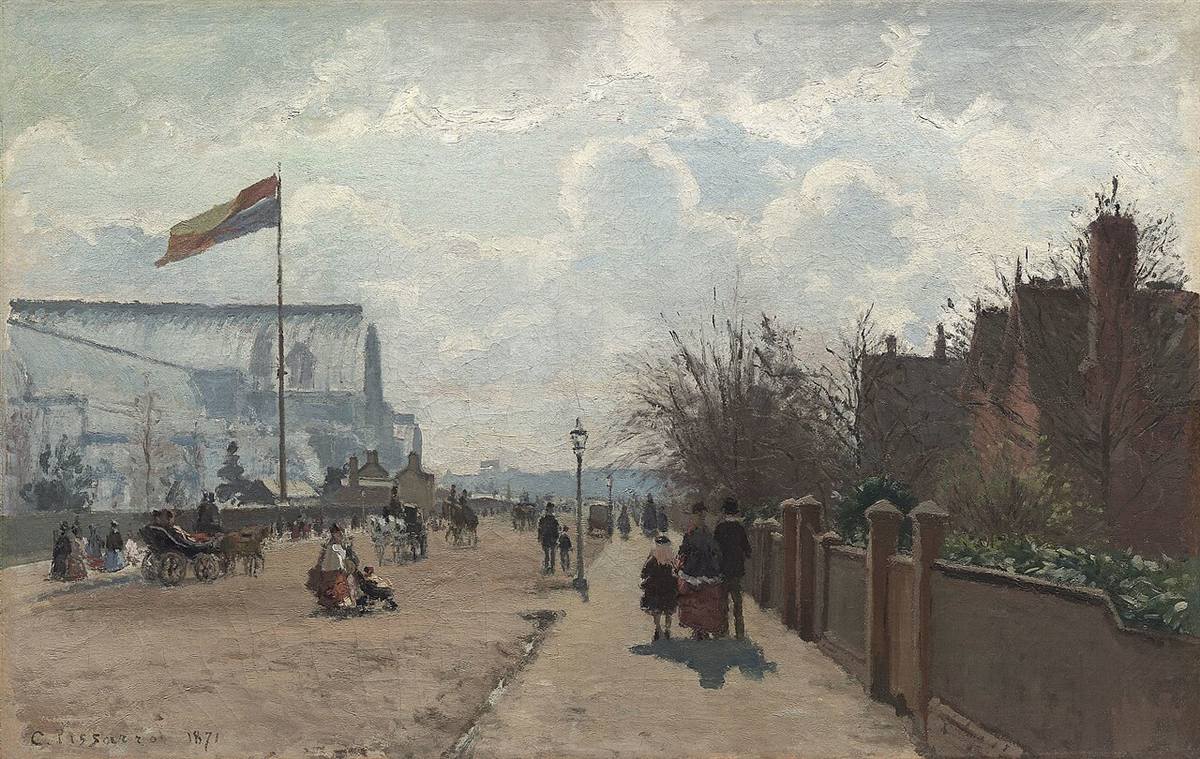
The Crystal Palace
Camille Pissarro · 1871
- Artist
- Camille Pissarro (French, 1830–1903)
- Date
- 1871
- Medium
- Oil on canvas
- Size
- 47.2 × 73.5 cm (19 × 29 in.); Framed: 72.4 × 98.5 × 12.1 cm (28 1/2 × 38 3/4 × 4 3/4 in.)
- Made in
- France
- Style
- Impressionism
- Where to see it
- Art Institute of Chicago
Gift of Mr. and Mrs. B. E. Bensinger · CC0 Public Domain · Art Institute of Chicago · image via Wikimedia Commons · see it at the museum ↗
Notes from the museum
Camille Pissarro and his family left France in 1870–71 to escape the Prussian invasion and subsequent civil uprising (known as the Commune). They spent these years in Lower Norwood, outside London. In the neighboring town of Sydenham, Pissarro painted the glass-and-iron Crystal Palace, which was originally designed by Joseph Paxton in 1851 for London’s Hyde Park. Although it was immediately acclaimed for its modern architecture, only two years later the building was dismantled and reassembled in Sydenham. (It was destroyed by fire in 1936.) In this small oil painting, Pissarro relegated what was considered the world’s largest building to the left side of the canvas, as if to give equal space to the “modern-life” scene of families and carriages parading by Sydenham’s more recently constructed middle-class homes.
Text: Art Institute of Chicago (open access). Our full story for this work is coming soon.
Slow Look
- The whole picture Let your eyes wander. Where do they want to rest?
- The light Find the brightest spot. What is it showing you?
- The edges Look at what is half cut off at the borders.
- One small detail Choose one tiny thing and stay with it for a while.
- The whole picture again Step back. Has it changed for you?
About Camille Pissarro
Jacob Abraham Camille Pissarro was a Danish-French Impressionist and Neo-Impressionist painter born on the island of Saint Thomas. His importance resides in his contributions to both Impressionism and Post-Impressionism. Pissarro studied from great forerunners, including Gustave Courbet and Jean-Baptiste-Camille Corot. He later studied and worked alongside Georges Seurat and Paul Signac when he took on the Neo-Impressionist style at the age of 54.
What do you see?
Stand in front of it for a moment. Then tell us what you noticed or felt - there are no wrong answers.
Be the first to share a thought.
More by Camille Pissarro
If you like this, stand in front of these