Tip: move over the painting to use the lens.
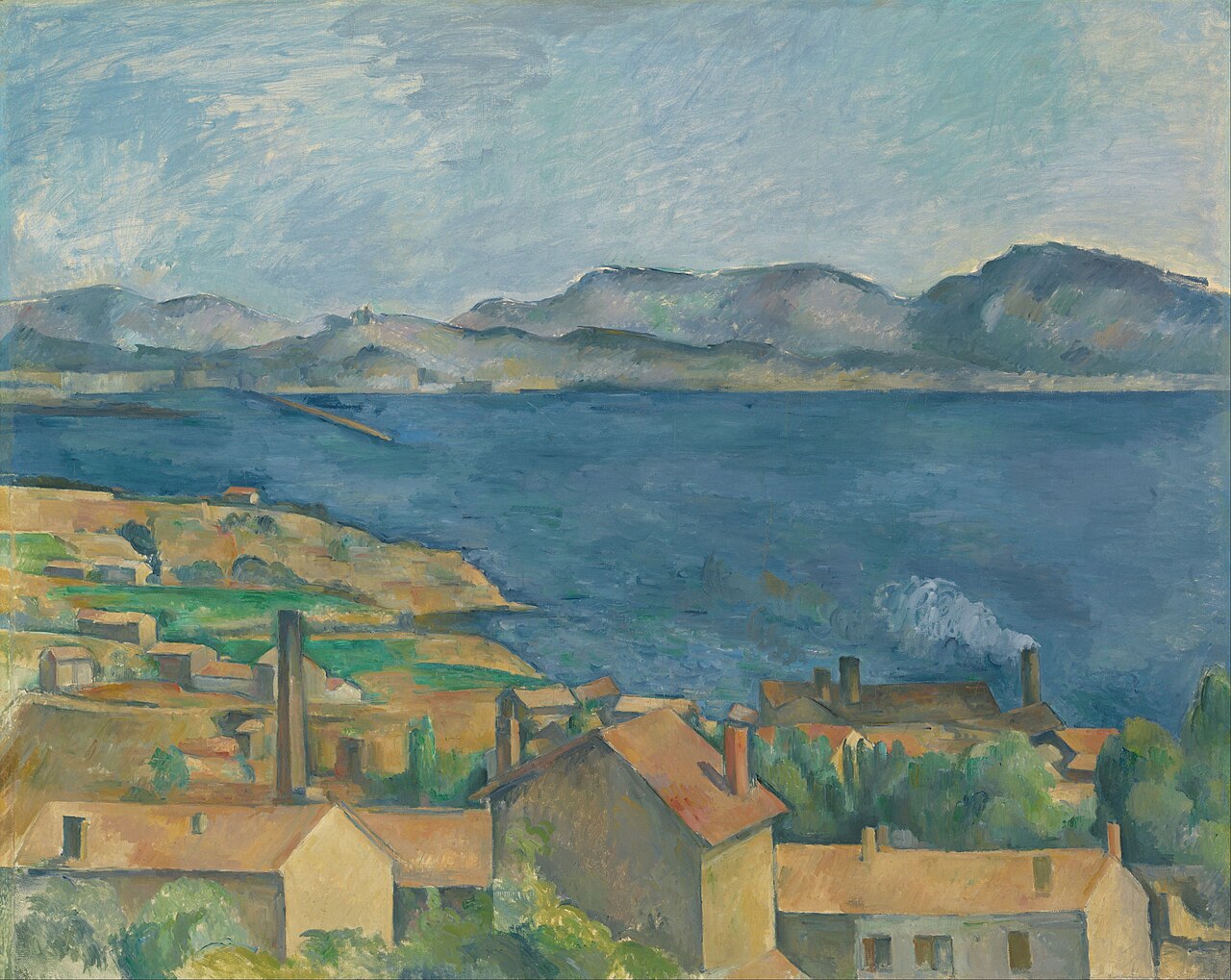
The Bay of Marseille, Seen from L'Estaque
Paul Cezanne · c. 1885
- Artist
- Paul Cezanne (French, 1839–1906)
- Date
- c. 1885
- Medium
- Oil on canvas
- Size
- 80.2 × 100.6 cm (31 5/8 × 39 5/8 in.); Framed: 107.4 × 127.4 × 10.5 cm (42 1/4 × 50 1/8 × 4 1/8 in.)
- Made in
- France
- Style
- Post-Impressionism
- Where to see it
- Art Institute of Chicago
Mr. and Mrs. Martin A. Ryerson Collection · CC0 Public Domain · Art Institute of Chicago · image via Wikimedia Commons · see it at the museum ↗
Notes from the museum
In a letter to his friend and teacher Camille Pissarro , Paul Cézanne compared the view of the sea from L’Estaque to a playing card, with its simple shapes and colors. The landscape’s configuration and color fascinated him. This painting is one of more than a dozen such vistas created by the artist during the 1880s. Cézanne divided the canvas into four zones—architecture, water, mountain, and sky. Although these four elements are seen repeatedly in Impressionist paintings, Cézanne’s work is very different from that of his fellow artists. Whereas their primary purpose was to record the transient effects of light, Cézanne was interested in the underlying structure and composition of the views he painted. Filling the canvas with shapes defined by strong, contrasting colors and a complex grid of horizontal, vertical, and diagonal lines, he created a highly compact, dynamic pattern of water, sky, land, and village that at once refers back to traditionally structured landscape paintings and looks forward to the innovations of Cubism. Using blocklike brushstrokes to build the space, Cézanne created a composition that seems both two- and three-dimensional. Not locked tightly in place, his forms appear to touch and shift continually, creating a sense of volume and space that strengthens the composition and brings it to life.
Text: Art Institute of Chicago (open access). Our full story for this work is coming soon.
Slow Look
- The whole picture Let your eyes wander. Where do they want to rest?
- The light Find the brightest spot. What is it showing you?
- The edges Look at what is half cut off at the borders.
- One small detail Choose one tiny thing and stay with it for a while.
- The whole picture again Step back. Has it changed for you?
About Paul Cezanne
Paul Cézanne was a French Post-Impressionist painter whose work introduced new modes of representation, influenced avant-garde artistic movements of the early 20th century and formed the bridge between late 19th-century Impressionism and early 20th-century Cubism.
What do you see?
Stand in front of it for a moment. Then tell us what you noticed or felt - there are no wrong answers.
Be the first to share a thought.
More by Paul Cezanne
If you like this, stand in front of these