Tip: move over the painting to use the lens.
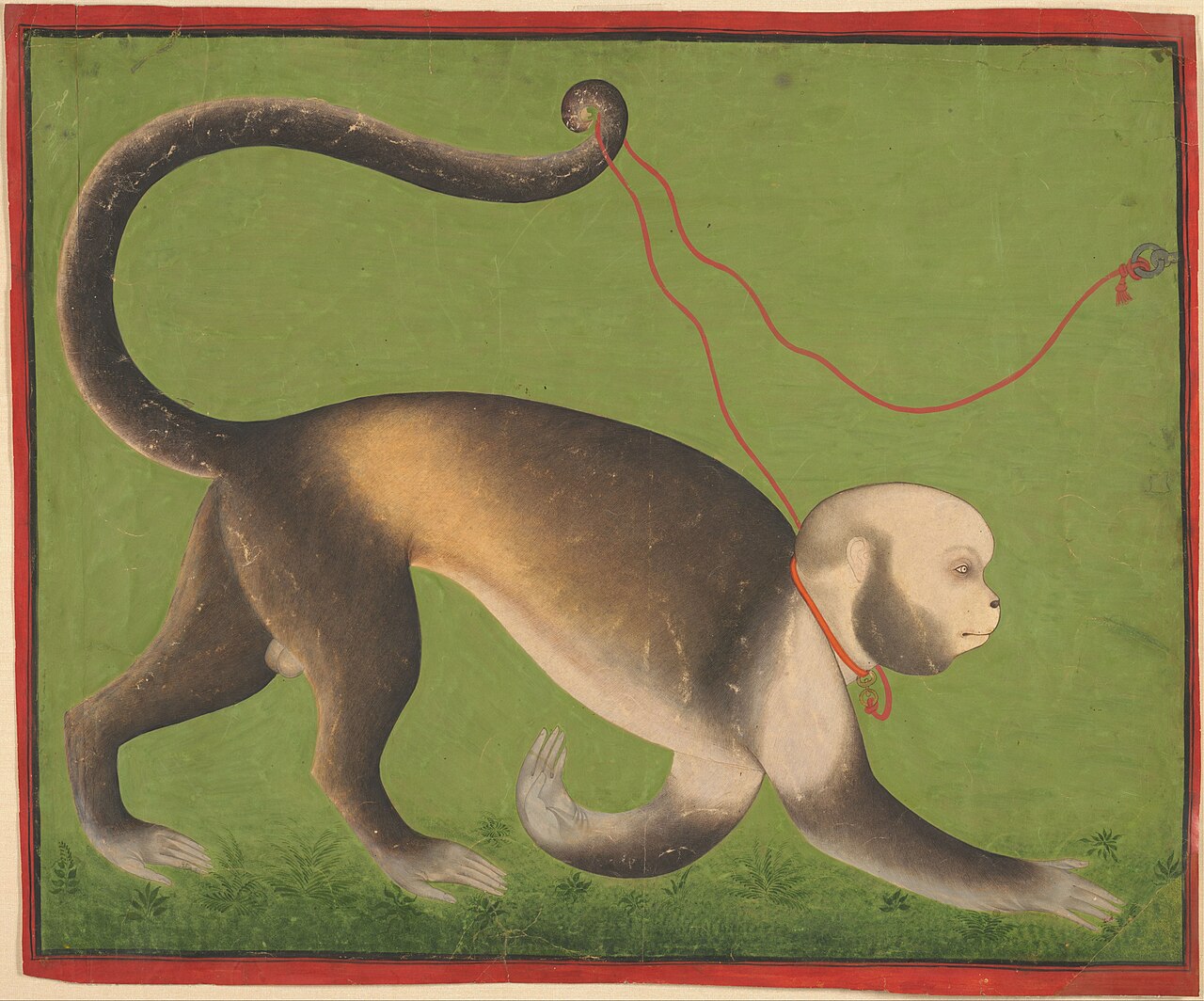
A Monumental Portrait of a Monkey
Unknown artist · c. 1705–1710
- Artist
- India Rajasthan, Mewar, Udaipur, attributed to the “Stipple Master” (active c. 1692-c. 1715)
- Date
- c. 1705–1710
- Medium
- Opaque watercolor and gold on paper
- Size
- Outermost border: 48.5 × 58.7 cm (19 × 23 in.); Image: 45 × 56 cm (17 3/4 × 22 in.)
- Made in
- India
- Style
- South Asian
- Where to see it
- Art Institute of Chicago
Lacy Armour Fund, James and Marilynn Alsdorf Acquisition Fund · CC0 Public Domain · Art Institute of Chicago · image via Wikimedia Commons · see it at the museum ↗
Notes from the museum
Except for depictions of the monkey-god Hanuman, monkeys are rarely the subject of portraits in India. In this monumental portrait, therefore, we are looking not only at an unusual subject matter but also at a study of an extraordinary simian: one with human features complete with a beard, pale eyes, and long, slender hands. The inscription on the back of this work, written in Devanagari, states that the monkey is named Husaini and “comes from” Nawab Davad (or Daud) Khan. This name most likely refers to Daud Khan Panni, a powerful nobleman and a faujdar (a military commander and territorial administrator) who served the Mughal emperors from Aurangzeb (r. 1658–1707) through Farrukhsiyar (r. 1713–19), in various parts of India. The painting has been dated to 1705/10 and is attributed to the anonymous artist now called the Stipple Master. Working in tandem with his patron Maharana Amar Singh II of Mewar (r. 1698–1710), this artist was the initiator of a new painting style in Mewar in the late seventeenth and early eighteenth centuries. A group of about forty-six paintings, including the present work, has now been attributed to this artist-patron duo.
Text: Art Institute of Chicago (open access). Our full story for this work is coming soon.
Slow Look
- The whole picture Let your eyes wander. Where do they want to rest?
- The light Find the brightest spot. What is it showing you?
- The edges Look at what is half cut off at the borders.
- One small detail Choose one tiny thing and stay with it for a while.
- The whole picture again Step back. Has it changed for you?
What do you see?
Stand in front of it for a moment. Then tell us what you noticed or felt - there are no wrong answers.
Be the first to share a thought.
More by Unknown artist
If you like this, stand in front of these