Tip: move over the painting to use the lens.
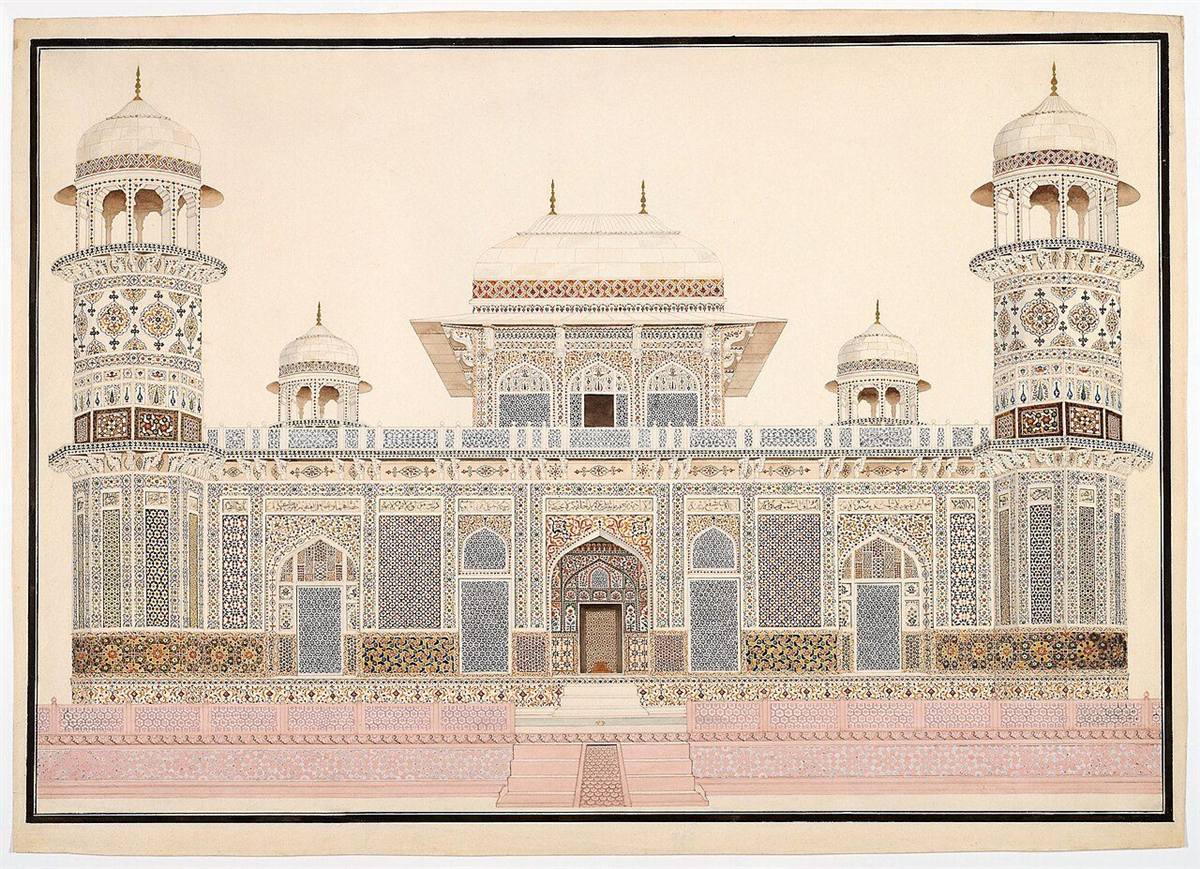
I'timad-ud-Daula's Tomb at Agra
Unknown artist · c. 1820
- Artist
- India Agra
- Date
- c. 1820
- Medium
- Watercolor on paper watermarked J. Whatman with pencil, pen, ink and gold
- Size
- 51 × 74 cm (21 1/8 × 29 1/8 in.)
- Made in
- India
- Style
- Indian (South Asian)
- Where to see it
- Art Institute of Chicago
Purchased with funds provided by the Friends of Indian and Islamic Art of The Art Institute of Chicago · image via Wikimedia Commons · CC0 Public Domain · Art Institute of Chicago · image via Wikimedia Commons · see it at the museum ↗
Notes from the museum
This architectural rendering of a magnificent tomb at Agra provides an accurate depiction of the semiprecious stones inlaid in white marble, a technique known as pietra dura, and the carved white marble jali screens of the mausoleum built by the Mughal empress Nur Jahan (1577–1645). She commissioned this building in honor of her father, Mirza Ghiyas Beg, who rose to become the prime minister under the emperor Jahangir (reigned 1605–27) and held the exalted title I’timad-ud-Daula (Pillar of the Empire). The powerful Nur Jahan had immense financial resources at her disposal. Built between 1622 and 1628 and modest in size, as befitted the mausoleum of a nobleman rather than an emperor, the structure is unique in its lavish epigraphic and decorative design, highlighting its exquisite quality and craftsmanship. This drawing was created in the Company style, named after the British East India Company, which led English mercantile and political interests in the subcontinent from the early seventeenth to the mid-nineteenth century. British colonists were eager to record and catalogue everything they saw. In the absence of photography, British and Indian artists depicted the sights in finely detailed prints and drawings. The style arose in the later part of the eighteenth century and ended in the mid-nineteenth with the beginning of photography. In addition to rendering architectural dr
Text: Art Institute of Chicago (open access). Our full story for this work is coming soon.
Slow Look
- The whole picture Let your eyes wander. Where do they want to rest?
- The light Find the brightest spot. What is it showing you?
- The edges Look at what is half cut off at the borders.
- One small detail Choose one tiny thing and stay with it for a while.
- The whole picture again Step back. Has it changed for you?
What do you see?
Stand in front of it for a moment. Then tell us what you noticed or felt - there are no wrong answers.
Be the first to share a thought.
More by Unknown artist
If you like this, stand in front of these